GJ 1214 b: beyond the water-world headline
An intriguing planet became a lesson in the difference between a beautiful possibility and a measured atmosphere.
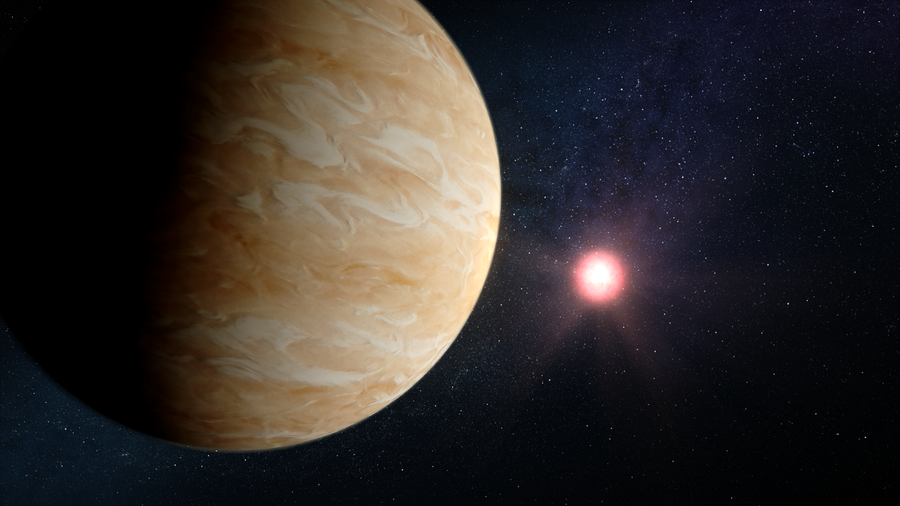
Artist’s illustration · NASA, ESA, CSA, Dani Player (STScI) · View image source ↗
The world beyond the headline
About 48 light-years away, in the direction of Ophiuchus, GJ 1214 b belongs to the sub-Neptune class: a size of planet that our own solar system does not conveniently supply. Its appeal is partly that unfamiliarity. To understand it, scientists cannot simply point to a neighbouring planet and declare the problem solved.
Earlier discussion included the possibility of a water-rich world. That image is memorable, but an interpretation of incomplete data is not a photographed ocean. No ocean or life has been established on GJ 1214 b.
What changed with Webb
The University of Arizona’s 24 January 2025 account describes Webb observations, atmospheric modelling and a small carbon-dioxide signal. The researchers favoured an atmosphere rich in elements heavier than hydrogen and helium, with carbon-rich possibilities beneath thick aerosols. The associated paper explicitly describes its interpretation as possible.
In astronomical usage, ‘metals’ includes elements heavier than helium. It does not mean the planet’s air is a cloud of iron filings. Nor does a carbon-dioxide signal identify an ecosystem. The interpretation depends on the full spectrum, the models and their uncertainties.
Why uncertainty is part of the adventure
The method matters as much as the attractive illustration. Ask which feature was measured, how strongly, and which models can reproduce it. Ask whether a new observation distinguishes those models. A planet can become more interesting when a simple label stops being adequate.
The magazine’s question about meeting its inhabitants is a thought experiment. The actual scientific story is the effort to read an unfamiliar atmosphere from a very great distance.
GJ 1214 b need not be inhabited to expand our imagination. It already reminds us that nature is not limited to the planetary designs we grew up beside—and that discovery sometimes means replacing a lovely first picture with a stranger, better-supported one.
Sources & further reading
- University of Arizona · Atmospheric findings, 24 January 2025 ↗
- University of Arizona · Research paper record ↗
Sources support factual background. Thought experiments and editorial interpretations are labelled above.